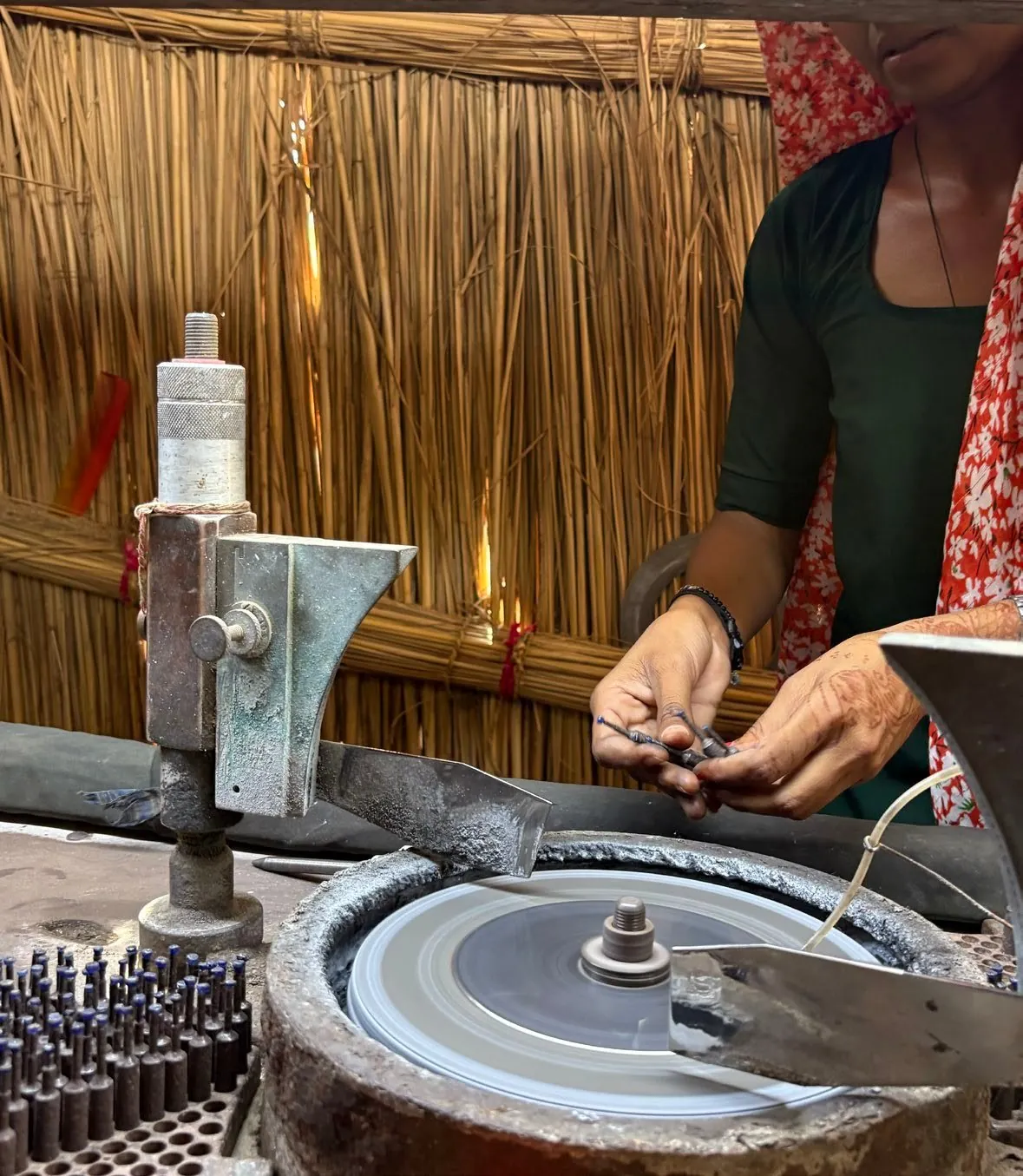

Where Do Women Sell?
80 conversations with women running small businesses in Kerala and Rajasthan: where their customers come from, what brings them back, and what they lose when someone else does the selling.
- Status
- Published · 2026
- Full title
- Beyond the Marketplace: Journeys of Grassroots Women Entrepreneurs
- Authors
- Niveditha Rajesh and Viney Jain
- Published by
- LEAD at Krea University
- Fieldwork
- Kerala and Rajasthan, about a month in each, on site
- Method
- 80 in-depth interviews, recorded on video with consent, read alongside field notes
- Read it
- Full report (PDF)
- My part
- Co-author with Niveditha: fieldwork, interviews, analysis and writing
Why we asked#
Women running small businesses in rural India are usually described by what they lack: capital, mobility, training, access to markets. Much of that is real. But a great many of them are already selling something, week after week, without a shop, a brand or a marketing budget. So we started from a different question. How are they doing it? Where do the customers come from, and what brings them back?
State missions like Kudumbashree in Kerala and Rajeevika in Rajasthan now connect women to fairs, buyers, government orders and online platforms. A woman counts as "market-linked" when one of those connections happens. We wanted to know what the connection leaves behind.
Who we met#
- Mostly in villages and small towns, connected in some way to self-help groups
- Food processing and catering, tailoring, crafts, soap and cosmetics, small manufacturing
- Some worked from home, some from small units or as a group; some had just started, some had run for more than twenty years
- Smartphones and WhatsApp were common for business, and many already took digital payments
We reached people through Kudumbashree and Rajeevika, and through referrals from entrepreneurs and other contacts. The missions did not choose who we spoke to. Everyone we met was already making and selling something, so the findings describe different journeys, not all women entrepreneurs.
What we found#
1. Where does a market begin?#
Usually with someone she already knows. Shabeena started her catering business in Thrissur ten years ago, when her father connected her to a family that needed food for an engagement. They liked it and came back with a bigger order. Today she cooks for weddings, office lunches and family functions, with no storefront, no signboard and almost no advertising. Ask her where she sells and she doesn't name a place. She sells wherever the next function is, to whoever has been given her number.
Indu made her first sale at a stall at her daughter's school, where she was already known as a parent. A cosmetics maker in Thrissur found her first customers among her daughter's classmates, who'd noticed the soap she made for her daughter's skin.
2. When does one sale become a relationship?#
When the buyer can find her again. Kiran Devi hand-prints fabric in Bagru and sells mostly at fairs. She gives her visiting card to the people who buy from her. They call later, ask for photos, order by phone, and she sends the fabric by courier. Jincy keeps her tailoring customers in a WhatsApp group where she posts new designs. If she has your measurements, you can order from home.
At least 50 to 100 customers are connected to us like this.
Kiran Devi, block printer, Bagru
3. Whose number is on the packet?#
Many products we saw had a phone number printed on the packet. When a customer wanted to order again, that's the number they called. It wasn't always hers.
Vanaja, Kerala
Customers call numbers used by her son and daughter-in-law. They take the orders, and digital payments go into their accounts. The family's help let the business grow, but the customer contacts are now partly with them.
An incense maker, Rajasthan
Her husband buys the sticks and scent, supplies the shops nearby, and the money goes into his account. When we asked what the business earns in a month, she said her husband knows.
Hima, Kerala
Some bulk buyers sell her packaged food under their own sticker. The orders are big, but her name isn't on the packet, so she doesn't know who ends up buying it or what they think.
The people in between were often doing useful work: selling online, dealing with shops, arranging transport, collecting payments. What mattered was whether information about customers, prices and demand still reached the woman who made the product.
Women who knew the terms could use middlemen well. Indulekha, who runs a flour mill, gives distributors about 25%. They take her products to shops across Kerala and chase the payments, which she'd found hard. Mini Mohan sells her clay pots for about ₹50. During our conversation she found out that similar pots sell online for ₹350 to ₹400.
One clay pot, two prices
4. Can the product sell without her?#
Face to face, a customer can ask about ingredients, use and shelf life. On a shop shelf, the packet has to answer. One soap group did well at local stalls and at an exhibition at Jaipur Club, but shops wanted better packaging. That would have cost ₹7–8 a bar, enough to wipe out their margin and price out the village customers who already found the soap expensive. The group stopped making soap. In Kerala, several mills couldn't meet the packaging supplier's minimum order on their own, so they pooled their orders and sold under shared Kudumbashree branding.
5. What happens when the market moves online?#
Most women already used WhatsApp to sell to people they knew. Mamta finishes sarees in Rajasthan and posts them on her WhatsApp Status; her contacts message her to reserve the colours they like. Selling to strangers is harder: photos, questions, payment, delivery, returns, and trust on both sides.
Komal, Jaipur
Bulk buyers find the family's blue pottery business on IndiaMART, and the order is settled on WhatsApp. Their Instagram page hadn't brought a single sale. She also gets calls from people claiming to be from platforms, and some sounded like scams.
Kiran Devi, Bagru
Has an Instagram page but doesn't post her designs. She worries they'll be copied and she'd have little she could do about it.
Sushila, near Jaipur
Makes juttis and bags. She worries about pressing the wrong button and posting something by mistake. She'd gladly supply an online reseller, or use a simple platform if someone walked her through it.
6. The next market#
Most women could name exactly what stood between them and the next market. Ramas Devi has ten machines and a dozen workers; she needs regular orders. Jincy's shop is upstairs, so few people walk in; she thinks a ground-floor shop could roughly double her sales. Savitri Devi sells camel-leather juttis at fairs. When we asked why she doesn't sell online, she said she doesn't have GST registration.
Growth wasn't only about money. Usha runs a low-cost food outlet that supports six households, with tea at ₹10 and kanji at ₹30. Customers tell her to raise her prices. She keeps them low so poorer customers can still eat there.
Four questions to ask after a sale#
Why it matters#
Two women can both "sell" and run very different businesses. Kiran Devi says around a hundred customers stay in touch with her after fairs, so her next order can come straight from one of them. The incense maker couldn't tell us what her business earns. Her next order still depends on her husband.
- If you build for small sellers: what matters is whether the customer's number, the price and the feedback stay with the person who made the thing.
- If you lend to them: many of these businesses sell every week, but the record can sit in a relative's account or under a buyer's label. Neither the lender nor the owner sees all of it.
- For me: it's the same idea behind Kaari: the artisan's name and village on every product, and the shop run from the artisan's own WhatsApp.
Authors: Niveditha Rajesh and Viney Jain. Research and fieldwork guided by Sharon Buteau and John Victory Arunkumar at LEAD; editorial inputs from Diksha Singh and Shanmugam Manoharan. With thanks to Kudumbashree and Rajeevika for supporting the field visits, and to every woman who gave us her time.