
The Kalamkari Project
Who paints Srikalahasti's hand-drawn Kalamkari, how they're paid, and why young people aren't joining. A survey of all 62 artisans in a set of private workshops.
- Status
- Published · 2025
- Full title
- The Kalamkari Project: Exploring Artisan Welfare and Livelihoods in Srikalahasti
- Authors
- Viney Jain and Niveditha Rajesh
- Guided by
- Prof. Sharon Buteau (Executive Director, LEAD at Krea University) and Prof. Sutapa Majumdar
- Fieldwork
- Two months on site in Srikalahasti, Andhra Pradesh
- Method
- A survey of every artisan in the selected workshops, plus interviews with the workshop owners
- Read it
- thekalamkariproject.in
- My part
- Co-author with Niveditha: survey design, fieldwork, analysis and writing
The craft#
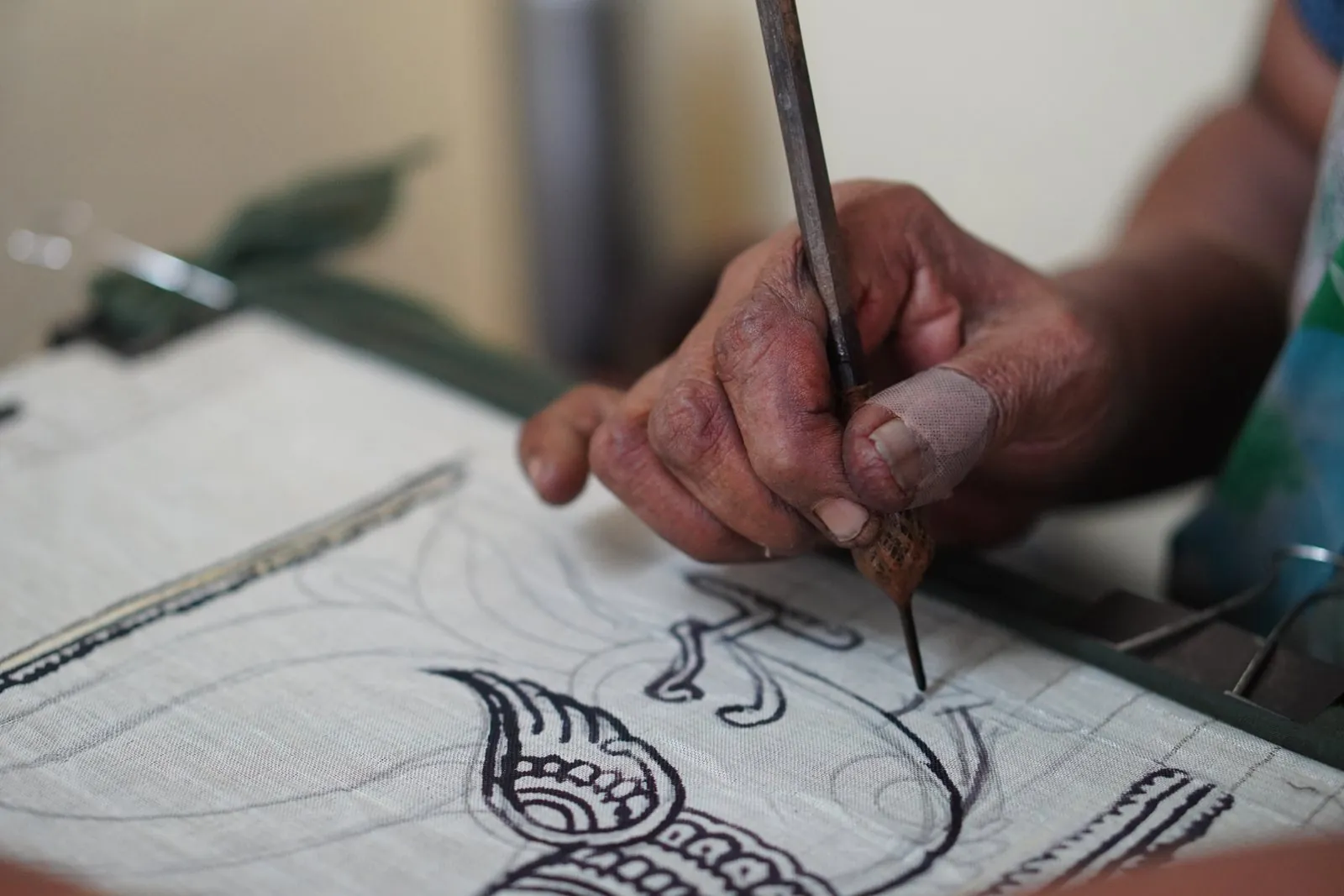
Kalamkari gets its name from Persian: kalam, pen, and kari, craftsmanship. In Srikalahasti it's drawn freehand with a bamboo pen and filled in with natural dyes, a tradition that grew out of temple cloths and got a GI tag in 2013. The cooperatives that once supplied raw material, credit and buyers have faded. Today most artisans work in small private workshops, some of which still call themselves societies.
What we asked#
How do employment structures and changing generational attitudes impact the welfare and future aspirations of Kalamkari artisans in Srikalahasti?
What we found#
How the 62 artisans work
How they're paid
- Cash · 90.3% · 90.3%
- Bank transfer · 6.5% · 6.5%
- UPI · 3.2% · 3.2%
How they found the work
- Word of mouth · 64.5% · 64.5%
- Recruitment drive · 14.5% · 14.5%
- Family · 12.9% · 12.9%
- Broker or agent · 8.1% · 8.1%
Most artisans earn ₹6,000–10,000 a month, in a range of ₹3,000 to ₹60,000, for about seven hours a day, six days a week. Designers earn more than painters and washers. Most of them started out drawing or painting, but few younger artisans want to spend the time it takes to learn design.
Painting is women's work, and the schemes don't reach them#
Master craftsmen often draw the outlines. The painting, filling in colour with natural dyes, is done almost entirely by women, many of them housewives who heard about the work from other women. Pay is regular. But 69.4% have no artisan card, the ID that opens up welfare schemes, training and loans. Only 11% had heard of any scheme, and just one artisan had used one. The schemes mostly reach workshop owners, not the people doing the work.
Why young people aren't joining#
Low pay, no job security, and the heat, chemicals and fatigue of the work. Older artisans told us newcomers want quick money, not a year of learning. Since COVID, many women prefer to take pieces home to paint. It's more flexible, but it has weakened the shared learning that used to happen in the workshop.
In their words#
I learned this art 45 years ago, but I have not passed it on to anyone. Whatever I know will die with me.
V. Srinivasulu Reddy, Shilp Guru awardee
He added: "If anyone is willing to come and stay here to learn for a year, I will happily teach them. But no one is ready."
Thakkuva salary… interest vundhu.
M. Nagaraj, 72, forty-five years in the craft
Low salary, but there's interest.
This work gives me purpose beyond household duties.
Devi, 55, two years at a workshop
What it led to#
This is where Kaari came from. On the same trip we met a Shilp Guru with Pen Kalamkari paintings worth more than ₹25 lakh stacked at home, and no way to reach buyers who don't speak Telugu. Read about Kaari →
It also changed how I think about money for small businesses. When nine in ten workers are paid in cash and most don't have the ID that schemes and loans ask for, there's no paper trail for anyone to lend against.
Authors: Viney Jain and Niveditha Rajesh. With thanks to Prof. Sharon Buteau, Prof. Sutapa Majumdar, Arul Raj and the artisans and workshop owners of Srikalahasti.